How to Treat Dry or Dehydrated Skin with Glossier Skincare
1
Is Your Skin Feeling Dry or Dehydrated?
On good days, your skincare routines feel like a breeze. Even the simplest step, perhaps just misting your face with your favourite face mist, feels like it’s enough, like it could carry the weight of a 10-step routine. But when the day suddenly seems to slant, things with your skin start going awkward. Like your skin starts to feel dry and tight, but when you bring your finger up to touch your face, you find a thin layer of shiny sebum sitting on your fingertip. You get confused. Sometimes, when it feels like you’ve tried everything but things still go back to the way it once was, you feel like giving up. At least, that’s the way things are for me. Until now.
Everyday, it feels like a battle against my skin. But over time, I started changing the way I think about my skin. Once, I used to hate that it’s so unpredictable. As days go by, I try to remind myself that I should treat my skin the way I would treat anyone in a relationship: with kindness and some spontaneity, because let’s be honest, we can’t know everything that’s going to happen as the relationship progresses. Besides, you’re going to need your skin to be your best friend and closest confidante in this hurdle against skin-related uncertainties.
Specifically, I go through ups and downs with skin dryness or, to put it in relation to having skin that produces too much sebum, I constantly have dehydrated skin. I have quite a number of hydration and moisturizing products, but in this article, I will be sharing on the Glossier products that have helped me deal with dry skin/dehydrated skin. Perhaps you too are looking at Glossier to fix your dry or dehydrated skin issues, and you might ask, “Is Glossier good for dry or dehydrated skin?” My short answer is yes, to my experience at least. And the long answer? Well, go ahead and find out below what I’ve experienced with each product!
2
Glossier Products for Dry/Dehydrated Skin
I have decided to categorise the products I use into Essentials and Extras. This is to differentiate between what I use daily and what I use as a hydration booster. Here is the list of products that I’ve used to help combat dry/dehydrated skin:
- Essential
- Milky Jelly Cleanser
- Super Bounce
- Priming Moisturizer Rich
- Priming Moisturizer
- Extra
- Soothing Face Mist
- Futuredew

3
Essential #1: Glossier Milky Jelly Cleanser
The first step of my skincare routine is to start with a facial cleanser. For this I use Glossier’s Milky Jelly Cleanser. The first time I heard about Milky Jelly Cleanser, I wasn’t so sure it would help with cleaning my skin of impurities. I mean, that’s the least a facial cleanser is supposed to do. For some odd reason, I always thought of Glossier’s skincare line as more of an “after facial cleanser” kind of thing, like moisturisers and serums.
I only got into trying Milky Jelly Cleanser when I finally believed that facial cleansers are an important first-step in any skincare routine, because it’s in this step that we actually rid our skin of germs, dirt and grime. And only when I started to have an open mind about trying to change my facial cleanser to see if things could get better, I also found out that not all facial cleansers are made equal.
Obviously, Milky Jelly Cleanser is one of those cleansers that claims that it doesn’t strip your skin off of important oils or nutrients it produces naturally while it takes away the dirt. Also, it’s said to maintain your skin’s pH level at around pH 5, which is the ideal skin pH level. I was attracted to the idea that a facial cleanser could take away dirt while leaving everything else intact. And so, to entertain that idea, I went online, added it to cart and got it drop-shipped from the USA to Singapore just to make my final verdict.
Simply put, I have upgraded from the mini size to the standard size on my next purchase because it’s that good. Milky Jelly Cleanser is truly the first cleanser I’ve used that actually gets rid of dirt while not making my skin feel taut and tight. Plus, it makes a perfect canvas for receiving hydrating and moisturizing products. Bonus: it smells heavenly with its rosewater scent. Absolutely stunning piece of product, by far my favourite of all Glossier products put together.
Read More: You can read more of my review on Milky Jelly Cleanser here.

4
Essential #2: Glossier Super Bounce
Speaking about favourite products, Glossier’s Super Bounce comes in at a close second. Before I had Super Bounce, I was using Bybi’s Mega Mist (and still am using!). It’s a hyaluronic acid mist that I use on and off when I need it as a boost. As for Super Bounce, it’s a serum with hyaluronic acid and panthenol as its active ingredient. Till today nobody knows how much of each is in the Super Bounce serum, and Glossier has been otherwise hunted by critics for this lack of transparency.
But, according to my skin, it enjoys Super Bounce hella much when I massage it into my skin. There’s a slight tingly feeling, most likely from the hyaluronic acid as it’s able to give off that effect at certain amounts. When I’m done massaging it into my skin, my skin feels freer and supple, just drinking in whatever good food I give it to fight the dehydration and dryness. After a minute or two when it’s totally sunken in, it leaves a gleaming, healthy layer of moist-ness and natural glow. When I look in the mirror, I feel fresh and am just loving how it feels on my skin. All in all, Super Bounce does deliver the bounce in its name, and I depend on it nightly for daily hydration.
Read More: Find out more about what Glossier Super Bounce did for my skin in this review.


5
Essential #3, Two Choices: Glossier Priming Moisturizer or Priming Moisturizer Rich
My very first Glossier purchase was the Priming Moisturizer Rich. I had no real reason when I first got it, just that I didn’t have a skincare product in a jar, and so I got one from Glossier for aesthetic reasons. So, as you can imagine, when I first started using Priming Moisturizer Rich, I wasn’t vibing with it much. I didn’t see the point of moisturizing if I was already hydrating my face with a face mist (read: Bybi’s Mega Mist), which is so much easier than massaging cream all over the face.
Only recently I read an article that said that a lot of people only moisturize their skin when the dry/dehydrated symptoms start kicking in. In truth, we aren’t supposed to treat moisturization as a medicative step. Instead, it’s supposed to be a preventive step that stops dryness or dehydration from even coming close, if not never appearing again. And only after I knew this I started regularly moisturizing on top of hydrating.
As my skin is more dehydrated than dry, meaning it lacks moisture rather than it lacks oil, I prefer to use moisturizing creams rather than facial oils. Here, I have two options: the first is the Priming Moisturizer Rich and the second is the Priming Moisturizer. I go for the rich when my skin feels extra dehydrated that I can feel the sebum separating into a separate layer on my skin, creating a film on my face. It feels even better when I use it after using Super Bounce. I don’t think Glossier ever said it, but layering skincare products from within the same brand feels like a natural step to take. Priming Moisturizer seems to work far better when I layer it on top of Super Bounce than on top of Bybi’s Mega Mist (during the days before Super Bounce came into my life).
Also, Priming Moisturizer Rich acts like an occlusive to seal in the hyaluronic acid that I applied on my skin with Super Bounce. This means that while Super Bounce sinks into my skin and gives it moisture, Priming Moisturizer Rich seals the gates on the moisture so that they can’t escape. In that way, my skin remains moisturized longer than without the occlusive moisturizing step.
And on days when my skin feels fine and I’m not battling terrible skin dryness or dehydration, I would swap out Priming Moisturizer Rich for Priming Moisturizer. The latter has a watery, not even cream or gel-like, consistency. I have to be careful every time I squeeze product out of the tube—I made the mistake of squeezing it hard the first time and a jet of product seemed to shoot out. I was so shocked it did that, haha. But other than that, it does a great job on those good days. At the very least, I am still moisturizing daily though my skin doesn’t feel dry or dehydrated.


6
Extra #1: Glossier Soothing Face Mist
Unlike most people who truly understand that the skin must remain hydrated and moisturized, I fail at this and hence only moisturize and hydrate once daily, during my night-time skincare routine.
During the day, I’m too lazy to moisturize. To at least curb the dryness or dehydration, I sometimes like to spritz my face with Glossier’s Soothing Face Mist. It has rosewater in it, which is known for its natural astringent property, meaning that it makes things smaller i.e. able to minimise pores, even if slightly, to protect the skin against dirt in the atmosphere.
On other days, I’m guilty of not moisturizing my face because I am just not the daytime skincare routine kind of person! It just feels really weird for me to be opening up these many bottles and carry out my skincare routine when I’m going to be out and about all day. But please don’t be like me. I’m trying to psych myself into thinking that I do need to moisturize my skin during the day, but just give me a little more time to get this.
Also, the other reason why I don’t feel like I need to moisturize my skin during the day is because the oil build-up from my own skin will render the moisturizer useless. I don’t think it’s right to think like this, because even I know it’s wrong. But I’m working on it, pinky promise!


7
Extra #2: Glossier Futuredew
Even less needed than spritzing my face with rosewater-scented Soothing Face Mist when compared to actually moisturizing with a proper cream or gel is Glossier’s famous Futuredew serum. For me, I see Futuredew as more of a cheekbone aesthetic than skincare, although it does have skin-moisturizing properties with its blend of oils. I use it sparingly because I don’t see it as an essential moisturizer/hydrator, but if you’re looking to have a “change of scenery” from using the two Priming Moisturizers, Futuredew feels like a glamorous option! I definitely use it for this reason, on days when I experience that unexpected confident boss babe moment.
Read More: Find out more about how I use Glossier’s Futuredew, especially for people with acne-marked skin.

8
Conclusion
So there you have it, the six Glossier products I use to combat dry or dehydrated skin. Let me know in the comments down below if you’ve stuck by any of these products as your holy grail to moisturized skin.
All products featured on Pinkermann.com are independently selected by the blog owner of this site. However, when you buy something through Pinkermann retail links, we may earn an affiliate commission.
Babyfacial + Super Glow: The Pair That Gives Glowing Skin

1
A Little Back Story
When I first got into skincare at age 21, I started feeling self-conscious about the condition of my skin. I’ve always known that it was oily and extremely prone to breakouts, but before that, I’ve always brushed it aside and called myself out on being unlucky to have such skin. I was in my last year of university when I started seeing—actually scrutinising—the skins of my peers.
Over time, I started feeling lower than them. I know, I was being totally unfair to myself for feeling that way and putting myself down when I should have stood up for myself. But if I hadn’t felt bad about my skin condition albeit a pretty normal thing to have oily skin and breakouts, I wouldn’t even have dived into the world of beauty products, much less dip my foot into it. And, I might not even have this blog in the first place. Aside from the bad skin, I managed to achieve some pretty awesome goals just by feeling bad about my skin condition. And, if it weren’t for my bad skin, I wouldn’t have set my eyes on one of the most raved about beauty products out there, and that’s the one and only T.L.C Sukari Babyfacial by Drunk Elephant.
2
About My Skin
It has been about two years since I started actively using beauty and skin products to improve the condition of my skin. And it is also during this time that I found out that my skin wasn’t oily, but actually terribly dehydrated. It’s so dehydrated to the point of overproducing sebum to make up for the lack of moisture. It took me pretty long to come across this piece of scientific information on the Internet that extremely oily skin could also be because the skin is so dehydrated that it tries to save itself but fails miserably. So, when I found about this, I entertained the possibility that my skin could be suffering the same thing.
I bought a bunch of moisturisers and hydrators (my fave hydrator being Bybi’s Mega Mist, excellent stuff in there with hyaluronic acid) and started testing this new hypothesis. Lo and behold, it’s actually true. It was that simple, but I hadn’t figured out until now, always thinking that my skin was naturally oily. (But in truth it is oily, on my back especially.)
The one that has remained true all these years is the acne on my skin, with its persistent reappearance time and time again. At this point of time, I’ve found two things that help kill it: Sebamed’s Anti-Pimple Gel to attack deep-seated pimples (whether they have a head or not) and Cosrx’s Acne Pimple Master Patch for pimples with a head (I’ve found that it works slower than Anti-Pimple Gel to get rid of it). But because I’ve only discovered these products many years after the advent of the acne fest on my skin, I already have quite a lot of acne scars, holes and pigmentation. Lastly, to tackle pigmentation, I use Palmer’s Dark Spot Corrector Fade Serum and Fade Cream which have retinol in them.


3
My Skin’s Status Before Using T.L.C Sukari Babyfacial
As it has been two years since the start of my beauty/skincare journey, I’ve come across plenty of products and have tried a handful as well. To this day, there are only a few that I’ve continued to keep on hand. Here is a list of skincare products I use regularly and my purpose for using them:
- Facial Wash: Glossier’s Milky Jelly Cleanser
- Hyaluronic Acid Hydrator: Bybi’s Mega Mist
- Moisturiser: Glossier’s Super Bounce
- Toner: Sebamed’s Clear Face Deep Cleansing Facial Toner
- Anti-acne Treatment: Sebamed’s Anti-Pimple Gel & Cosrx’s Acne Pimple Master Patch
- Anti-pigmentation: Palmer’s Dark Spot Corrector Fade Serum & Fade Cream
Just with this list of products, I have achieved positive results so far and happy to say that they will remain in my beauty cabinet for as long as I don’t encounter something better that might replace them, or at least until they become discontinued items, thus forcing me to look elsewhere for a replacement. By this time, I am more or less pretty dang sure that my skin is healthy, despite the recurrence of acne. I know this because my skin is reacting positively to these products (especially treatment products like Anti-Pimple Gel and Fade Serum) and producing the goal effect of these products within the expected time frame.
4
Anatomy of T.L.C Sukari Babyfacial
Now that we’ve set the stage for the experiment, we can finally get into the main part of this post: T.L.C Sukari Babyfacial. From this point forth, I will refer to T.L.C Sukari Babyfacial as just Babyfacial for ease of communication.
When I finally got my own bottle of Babyfacial in the mail, I was pretty sure too that my skin was finally ready to be bombarded by a dollop of acids. (I mean, I graduated with a bachelor’s in chemistry, and I kind of miss all those hours of lab sessions when I was still in school.) Besides, I didn’t actively exfoliate though I had one tube of Bio Essence’s Bio-Renew Royal Jelly Exfoliating Gel, which I think is a pretty good exfoliator for beginners (if there’s such a thing, that is.)
Also, the last time I used an AHA product was many years ago when I tried to dip my foot into skincare but didn’t really come through then. And that product was Mario Badescu’s Glycolic Acid Toner. Wonderful stuff actually, that toner, but I was a broke student then to afford such a toner that I would like to use daily.
So, Babyfacial is an exfoliating mask that comes in a pink and white bottle with a pump mechanism to let out its creamy, beige-orange formula. It’s well-known for its industry-strength hydroxy acids, containing 25% AHA (glycolic, tartaric, lactic and citric acids) and 2% BHA (salicylic acid) as its active ingredients. The alpha hydroxy acids (AHAs) are meant to exfoliate dead skin cells on the surface and accelerate surface skin turnover to reveal a brighter, smoother complexion. This here, I believe, because I’ve experienced using Mario Badescu’s Glycolic Acid Toner and it does brighten the skin after many uses.
The lone beta hydroxy acid (BHA), salicylic acid, on the other hand, works not only on the outside (like the AHAs) but also on the inside to unclog pores and break down sebum in pores and hair follicles. They access these deep crevices by easily penetrating the lipid (read: fatty or oily) layers of the skin because of its likeness in chemical structure to lipids. BHAs main goal is to attack comedones made up of dead skin cells, sebum and bacteria that can turn into acne, thus breaking them down and then flushing them out of your skin as, what I like to call, “exfoliating residue”.
Babyfacial also contains chickpea flour and niacinamide (Vitamin B3) as two of its many secondary active ingredients of which I’d like to highlight. Chickpea flour has a pretty solid list of good properties, but I’d like to mention just two: chickpea flour’s zinc content which helps fight bacteria thus is useful in combating acne, and also the fact that it helps soothe inflamed skin. This is particularly appropriate in Babyfacial as the high acid content (at a whopping 30%!) can be harsh on the skin.
As for niacinamide, it protects against oxidative stress, meaning that it contributes to cell regeneration, hence smoother skin, fewer acne and pimples, reduced fine lines and wrinkles, minimised pores, and all that jazz. It also helps protect against sun damage and at the same time helps to lighten hyperpigmentation. Talk about an all-in-one ingredient. Beats me that Glossier hasn’t restocked its Super Pure serum, because I’d like to try some of that niacinamide serum.
With its main ingredients listed as such, Babyfacial is meant to be an at-home “facial” that resurfaces to reveal greater clarity, improved skin texture and tone, as claimed by Drunk Elephant. Taking their word for it, let’s jump right into the Application.


5
The Application of Babyfacial
Before putting on Babyfacial, I would cleanse my face with Glossier’s Milky Jelly Cleanser, for this cleanser is a soft one that takes away only surface-level dirt but does not destroy your oil barrier. Which is an important thing to take note of if we’re using Babyfacial after that, because you don’t want a completely stripped skin to be attacked by hydroxy acids. That’s going to be some painful, tingling masking there.
When I’ve pat my face dry, I would pump out a little bit of the beige-orange mask, about the size of fingertip. Then, I would spread it over on one side of my face, letting the formula thin out into a thin shiny layer. I would do the same for the other side of my face, and for my forehead. I’d make sure that every part of my skin has at least been covered by the mask, even if it’s thin. The thing about Babyfacial is that, even in small amounts, you can start to feel its effects.
For me, I feel a slight tingling around my nose area, and sometimes on the higher parts of my cheeks, around nose-level. This area of my face is the sensitive area. When all of my skin is covered, I’d wait it out for 20 minutes as recommended and do other things while waiting. About 3 – 5 minutes into the mask, the tingling sensation will start to dissipate, and by the end of the 20 minutes, it feels like you’re just putting on a heavy cream on your face and perhaps even thinking why in the world you tricked yourself into putting cake cream on your face even. At least that’s what I thought in the last few minutes of the mask.
When the 20 minutes were up, I would wash my face off with warm water (as recommended again). Once again, while rinsing the mask off, the piercing, tingling sensation would come back. This is the part where we are instructed to immediately apply the Virgin Marula Oil to ease the stinging. Tip: always keep this oil prepared just before you rinse the mask off. The experience is like a hot flash of a revelation, except it landed on your skin. But you needn’t worry; this goes away fairly quickly. Sometimes, I like to switch out the oil for Glossier’s Futuredew, just because it’s also technically an oil-based serum and I figured it could help matte out the sting. (It does, thank God.)
6
Any Results?
On my first try, I was (unreasonably) disappointed that Babyfacial’s magic didn’t work right away the way many people have experienced. My skin was its plain old self, apart from the fact that it feels a little uncomfortable because of the leftover tingling sensation. But then again, I kind of saw this coming because I’ve read other types of reviews where there were those who say they felt like they had wasted their money on an extremely expensive bottle of hydroxy acids that didn’t do anything for their skin. I was feeling a little conflicted because I waited a long time to finally get my hands on this expensive bottle of skincare and I wanted to like it so badly. I told myself that it’s okay, it’s only the first try. Perhaps for me, I’d need a bit more time for the mask to work.
So, I kept going for two more tries (once a week), and the results were still the same. At this point, I have psycho-ed myself well enough to take Babyfacial as more of a “magic that works inside” kind of product than a “results are visible to the naked eye” kind of product. At that time, I have “regrown” my love for Babyfacial purely for scientific reasons rather than physically aesthetic reasons.
Ha-ha, that is, until my fourth try that something really cool and totally unexpected happened.


7
I Started Using a Vitamin C Serum
Let’s backtrack to the 3 or 4 days before I tried Babyfacial for the fourth time. I just received a new package delivered to my doorstep, and it’s from Glossier. I had bought a bunch of skincare from Glossier, some of them were repeat purchases, and others new. One of those new ones was Glossier’s Super Glow, a Vitamin C + Magnesium serum in a 30-ml bottle. Two weeks before, I bought my mom Ordinary’s Vitamin C Suspension 23% + HA Spheres 2%. She’s been having a good time with it, just that it gives a bit of an itch when you first put it on. So, I decided to get myself Glossier’s Super Glow, since I was already using Super Bounce and needed to restock anyway.
8
Anatomy of Glossier’s Super Glow
Specifically, I bought a Vitamin C serum in the first place because of its brightening, dark-spot lightening and collagen-producing effects. I have never tried topical Vitamin C before and wanted to give it a try, as they say, believe it when you see it with your own eyes… I think that’s how that phrase went at least. As for Super Glow, the Vitamin C derivative that’s used is called Magnesium Ascorbyl Phosphate, a more stable form of Vitamin C, as Vitamin C is known to break down when exposed to light and heat, and can degrade over time with repeated exposure to oxygen in the atmosphere.
As for Super Glow’s magnesium component, I wasn’t well-versed in this mineral, but later found out that magnesium helps to regulate cortisol levels (stress hormones) and hormonal imbalances, thereby reducing acne caused by stress and hormone imbalance. Additionally, it has redness-reducing or anti-inflammatory properties that can liven up dull skin. On top of that, the ingredient called Evodia Rutaecarpa Fruit Extract has pretty strong anti-inflammatory properties. I take it that this ingredient backs magnesium in the department of anti-inflammation.
Overall, Super Glow seems like a pretty usable product, especially for people like my skin type/condition, with hyperpigmentation from acne scarring, occasionally inflamed pimples, and skin that’s in need of rescue from dullness. I’m also suspecting that my acne is mostly caused by hormonal imbalance because my chin and lower half of my face is acne-prone while my forehead remains squeaky clean. (For the record, it was the other way around when I was in my teenage years.)
In those short days before I tried Babyfacial for the fourth time, I applied Super Glow nightly. I would squeeze the orangey-white serum onto my skin, once each on both cheeks, forehead, nose and chin, in that order. I would then spread it out and massage it into my skin till the layer seems to be almost fully submerged, leaving only the remaining liquid that needs time to sink in on its own. Following this, I would apply Super Bounce.
The three days that followed after, I didn’t notice any visible change in skin texture, but I must say I did notice a slight brightening effect all over my face. In contrast, the hyperpigmented parts of my skin remained darker in comparison to the rest of my skin. But perhaps that was because all of my skin was lightening at the same rate. I mean, I might be kidding myself here, just hoping to see what I wanted to see. But if I was speaking the truth, this is the truth I’d tell you: Super Glow does work to brighten the entire face, but give it, like, a minimum of 6 months for you to see any contrasting change.
But that’s just the thing, right? We don’t have all year or half of it to remain true to a bottle of Vitamin C that feels like it’s working too slowly for our liking. So here’s what I discovered while testing out my new products…

9
Finally, The Results
On my fourth day of using Super Glow, I also finally jumped into my fourth use of Babyfacial. As usual, I wasn’t expecting anything different from the three tries prior to this. As I went on with my task with the Babyfacial mask on, all I could think of in the back of my mind was to tear the mask off my face because, to be honest, it does give a barely-there tingle that just keeps you awake at night. If you’re studying or working late and need to pull off an all-nighter, Babyfacial is certified company.
20 minutes later, I rinsed off the mask with warm shower-head water. I pat my face self-consciously, thinking about the absence of any visual improvement of my skin. I went over to the sink side of the bathroom and looked into the mirror and boy. Was. I. Floored.
Yeap—floored.
The unimaginable happened. That actual T.L.C Sukari Babyfacial glow was finally there, right there in the mirror, looking back at me. Excited yet? You bet, so here’s what this so-called glow looked like:
My skin was very much less dull, and a lot brighter. And under that sheen, my smoothened skin seemed to gleam. I turned my face slowly in different angles to examine the result, and it turned out fine. I wouldn’t go so far as to say that those hyperpigmented spots disappeared too, because, from my own experience, I’d need some kind of retinol targeting to get rid of them. But all in all, the glow was finally there.
The one thing that struck my memories when I first saw my illumined face was that I had only started using a Super Glow after three attempts of using Babyfacial and trying to get that brightened complexion. And it was only after using a Vitamin C serum prior to retrying a 30% hydroxy-acid mask that the brightening magic finally happened. I can’t say straight up that you have to use Vitamin C to make Babyfacial do its work, but it was a pleasant surprise that the results did come in.
The morning after that, I was still glowing, and my face was so bright I couldn’t believe it was my skin. I am obviously very happy with the results, after four weeks of trying Babyfacial to finally get the result I wanted, that is, with the help of Super Glow. Just for your reference, the glow remained for about 3 days, and it started fading back into my old complexion. I must say, though the glow didn’t last as long as I’d hoped it would, it must be my skin’s own natural chemical makeup, and I must be destined for this. As far as I’m concerned about getting good-looking skin, I’d have to put in that constant effort to make it last. Nothing is ever one-off, is it?
10
The Verdict: “Babe, You’re Glowing”
So, would I recommend Drunk Elephant’s T.L.C Sukari Babyfacial? Heck, yes. If you’re like me and not seeing results as quickly as you had hoped, add in an extra brightener like Super Glow into the mix while those AHAs and BHA exfoliators do their work to rid you of dead skin cells. While they’re at it, that Vitamin C component is brightening your skin and promoting production of collagen so you get skin that’s not just brighter, but resurfaced as well. Best of luck to you on your chemical glow journey!


All products featured on Pinkermann.com are independently selected by the blog owner of this site. However, when you buy something through Pinkermann retail links, we may earn an affiliate commission.
Glossier Super Bounce Review: Where Did You Go, Acne Scar?
Remember my other review on Futuredew which I first got in the Skincare Edit set? Similarly, I had my first bottle of Glossier’s Super Bounce from the fun-sized set too. Truth be told, Super Bounce was also my first serum in a long line of serums that came after that.
Let me walk you through my experience with Super Bounce and how I got it to work on my skin. Hint: the experience was a charming one, but obviously, all charming experiences take time to manifest.
The Colour & Consistency
As far as serums go in the scientific world, I’ve always thought of them as being thick and rich with active ingredients. (I’m a chemistry graduate, and before skincare, I only understood serums in the chemical way.) When I first opened the bite-sized 15 ml bottle of Super Bounce, and started testing the liquid’s consistency by letting drops of it fall back into the bottle, it gave me a sense of both confusion and awe. Never I thought that serums were this drizzly. As for the colour, it was what I had expected, it being thick, though white like milk.
The Scent
There was no apparent fragrance to Super Bounce because there is no added fragrance to it. There is though a slight scent to it, which smells like…bread soaked in milk. It’s a strange way to describe it but I’ve been smelling the same scent in other Glossier products. One example is Priming Moisturizer which has a scent stronger than Super Bounce. That being said, it isn’t actually that strong. It shouldn’t be something to worry about, if you’re looking to try it.
The Texture: What Super Bounce Feels Like On the Skin
You would have thought that since the serum has a pretty thin consistency, it would be too runny to be applied directly to the face. Contrary to that, it leaves a visible gleaming coat when I first spread it out on the back of hand. It is translucent enough that I could see my skin through it. When I spread it out some more, it thins out into a transparent layer. It feels and looks like water when it’s sitting on your skin. But after a couple of minutes, it sinks into the skin and leaves no residue.
And Perhaps a Slight Tingling Sensation
Here’s something to note. For some odd reason, the first time I tried Super Bounce, I felt a slight tingling sensation on the more sensitive parts of my face, like the skin around my nose and the corners of it. This sensation actually surprised me because Super Bounce looked like a mild-strength serum just based on appearance. But when I tried it on, it was obviously doing something to my skin. I couldn’t tell what was actually making that tingling sensation. But my closest guess would be the hyaluronic acid that was causing this. I’ve had the same experience with my Bybi Mega Mist the first time I tried it too. But over time, and in smaller doses, it’s actually all right and didn’t cause as much panic in me subsequently.
At this point, I should probably tell you that I’ve been enjoying Super Bounce when I first started using it. I liked how it left a pretty glimmering look on my skin. Because of this added effect, I didn’t fancy Futuredew as much as I was getting a similar effect from Super Bounce (though it lasts only a while until the serum dries off or gets absorbed completely).

But Does Super Bounce Actually Do What It’s Supposed To Do?
Before I found out Super Bounce’s other purpose, I only knew that it’s supposed to give you that ‘bounce’ to your skin through the application of hyaluronic acid. I found out only later that it’s supposed to make your skin appear smoother too, with pro-vitamin B5 (panthenol).
At this point of time, I was already about a week into using Super Bounce. In case you didn’t know, the effect hyaluronic acid has on the skin is immediate. Hyaluronic acid provides immediate hydration, making the skin look immediately plumper and healthier. Perhaps that’s why it’s recommended for people with dry skin or are travelling long flights. And additionally, for those with dry skin that breaks out easily because of excess sebum = dehydrated skin, getting an immediate hydration boost with a hyaluronic acid product helps to keep the skin’s sebum production in check.
On the other hand, while hyaluronic acid was doing a fantastic job at providing immediate hydration while also balancing out sebum production, pro-vitamin B5 or panthenol was taking its time to shine.
How Long & How Much Did I Use to Start Seeing Results?
I used Super Bounce for 14 straight days with no breaks in between days. Each night I used two drops on each cheek and my forehead, and one each on my nose and chin. I then massaged it into my face, making sure to cover the skin past my jawline. That’s the area that gets me a lot of acne too because of excess sebum.
What I Didn’t Do While Testing Super Bounce
Perhaps I should give you a little more context. During the 14 days I used Super Bounce, I was also religiously using Glossier’s Priming Moisturizer Rich as a moisturizing layer after the serum, and Glossier’s Milky Jelly Cleanser to wash my face before applying the serum. At the same time, I barred myself against using my go-to dark spot corrector. This is Palmer’s Dark Spot Corrector Fade Serum that has retinol in it. At that time, I, as usual, had dark spots/hyperpigmentation from acne scars. I wanted so badly to use the dark spot corrector but stopped myself lest I jeopardize my mini product test. (The retinol in it could skew results, making it seem as if Super Bounce was working better than it actually did.)
The Super Bounce Verdict: Smoother, Gleaming-looking Skin
At the end of 14 days, the results finally came in. My skin looked better than before, albeit not a complete transformation. Let’s be real, no product could actually work in just 14 days and give you baby-soft skin. But in view of my skin that’s riddled with acne scars, they looked less obvious and clearer. It’s weird if you tried to think about it. Acne scars become transparent, that is until your face turns another angle and the light falls wrongly. And then the deeply seated shadows expose the depth of the scarring for the world to see.
Apart from that negative effect caused by shadow and light, I would say pro-vitamin B5/panthenol actually did its job. Even my mother noticed that my skin looked smoother and less riddled than usual. It was definitely a strange experience, knowing that the potholes in my skin could never go away for the life of me. But it is also because of this less-riddled effect, and the fact that my sebum levels are being well-controlled, that I bought my second bottle of Glossier Super Bounce, full size at 30 ml. Funnily, my mother wanted to get her own bottle too after seeing the positive results on my skin. On another note, I’ve never gotten a zit from using Super Bounce, just as Jenna Birch from Self.com experienced. So, would I recommend it? A definite yes.
Shop Now: Glossier Super Bounce 30 ml
P.S. You, Yes You with the Oily Skin
But beware: I’ve read reviews from people with oily skin saying that Super Bounce makes their skin go nuts a.k.a over-produce sebum, which is the opposite (and the deadlier) effect from mine (the positive effect where sebum levels actually get controlled). So, give Super Bounce a chance at your own discretion. But if you need another reason to try Super Bounce despite all the warning signs, here’s an article on Byrdie.com that tells you why you should be using hyaluronic acid with panthenol. Hope this cheers you up!

All products featured on Pinkermann.com are independently selected by the blog owner of this site. However, when you buy something through Pinkermann retail links, we may earn an affiliate commission.
Glossier Futuredew Review: I Have Acne, Can I Use It?
All products featured on Pinkermann.com are independently selected by the blog owner of this site. However, when you buy something through Pinkermann retail links, we may earn an affiliate commission.
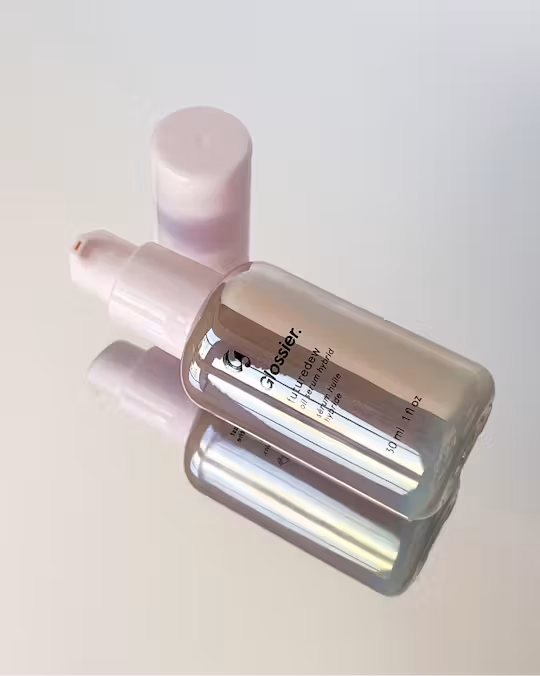
When Glossier dropped Futuredew back when things were going right with the world, it was the only bomb Glossier fans knew. Of course, I did too. But I only got my first bottle of Futuredew when they also dropped their Skincare Edit set. And that was when I knew I had to get the set because it also contained Super Bounce, which will be a review for another day.
1
The Colour & Consistency
I remember opening the paper mache-like box the first time I got it, the box with its moulds protruding outwards in the shape of its fun-sized contents. There, in it, lied Futuredew, baby pink and shiny and extremely cute looking because it was so small. It contains 15ml of the gel content and the bottle fits right in the palm of my hand. I pushed off the cap, letting it drop to the dinner table I was seated at, and just marvelled at the cute little snout of its pump. It’s like a real baby Futuredew. And then I pressed the pump lightly, and the shimmering pink-orange serum oozed out. Oozed out specifically because it was quite thin for a serum, or perhaps I was just not expecting it to be thin at all. (But I should have, since it’s obviously a blend of oils put together.)
2
The Scent
The pink-orange liquid sat on the back of my hand for a moment as I regarded it. And why exactly was I regarding it? It’s because I felt a little strange about it. It’s
I brought my hand near my face and smelled the liquid again. It had an earthy scent to it, pretty strong the first time because I didn’t expect it to smell earthy. Perhaps I was expecting it to smell citrusy because of its orange tinge, or even smell somewhat like Milky Jelly Cleanser, the smell of rosewater wafting up into your soul so nicely and easily. So that’s what I thought about the scent: perhaps I would prefer it to smell non-earthy. I think it’s also because the liquid is shimmery and pink, and it gives me a kind of seraphic vibe, which is, in other words, of angelic and hence of the heavens. So when I was met with the earthy scent, literally of the earth, my brain must have gotten confused.
3
The Texture
So then I, a Glossier fan (like most Glossier fans), tried to redeem the product in their own eyes. I proceeded to feel the texture of the product by rubbing two fingers on the liquid on the back of my hand, spreading it out. Just as I saw that the consistency of the liquid was quite thin, it also felt thin. It’s like a really thin version of oil. Now that I’m thinking about it and trying to find something to compare to, I realised it feels like the baby hair oil my mother used to rub into my hair when I was a kid. The hair oil was by Johnson & Johnson.


4
First Test on Acne-Scarred Skin
And when I spread the oil serum further out on the back of my hand, it kind of highlighted every nook and cranny in my skin. Not that my skin was cracking or anything, but those micro ridges became more prominent. At that point in time, I knew that was not what I wanted for Futuredew to do to my skin. Imagine this: the skin on my face is worse off than the back of my hand. And if layered with Futuredew, every little hole left by acne scarring will be made known to the world.
Believe it or not, there were other users who mentioned that Futuredew did the same thing to them: they didn’t like what it was doing to their face because it made their scars and pores ever more obvious. From that point, I thought that Futuredew was truly only suitable for people with extremely smooth and flawless skin, plus with no open pores.
So I gave Futuredew a rest for about a month or so, and then decided to pick it back up and try again. Only because I didn’t want to waste it as it’s lifetime from opening is only 6 months! That’s too short for me because I don’t normally use the same products every single day. My skin needs a bit of rest in between uses.
5
How to Correctly Apply Futuredew on Acne-scarred Skin
When I picked it up again, I decided I would try only a bit each time. Also, I finally got around to being all right with its earthy scent. But I would still prefer it if it smelled like Milky Jelly Cleanser, ha-ha.
Step 1: A Tiny Pump Goes A Long Way
I would press the pump lightly and let it stop and the slightest tug on the spring. This allowed for only a small bit of the serum to be dispensed, and could fit the tip of my forefinger. That’s how little I used every time I used it. It’s also pretty much a universal agreement that Futuredew works best as a highlighter than something to be spread full face.
Step 2: Tap on the High Points and Get the Rest of the Gleam Off
And then I would tap it on the high points of my cheeks. In the beginning the serum will still look really oily, so I would continue to tap until it evened out. The important thing to note here is to make sure that when you even out the serum across the area you’re targeting is to tap or rub it in lightly till you can’t see a gleaming effect. No gloss effect. Or, what Refinery29 calls the Krispy Kreme effect. If you leave it that way, it will definitely highlight not only your cheekbones, but also your large pores and acne scars. So don’t do that. Tap it out and even it out till the gleam is gone. Note: This step is the opposite of what Refinery29 stands for. My position is that the Krispy Kreme effect works best for people with really smooth, poreless-looking skin. For us large-pore gals, the opposite approach brings us the best results. So, get that gleam off, yeah?
Step 3: Blend it with Your Skin
And while you’re making that gleam effect disappear, remember to “blend” the shine of the serum to the shine of your own skin. This will make the transition between skin and serum look really smooth and just plain perfect. If you leave this part out, you’ll get that oil-layer look which makes it very obvious that you had something on your face. Blending the serum out to meet your skin’s own shine is extremely important to achieve that naturally glowing look. And that’s the purpose of Glossier’s Futuredew: getting the Glossier Skin as some people have called it.
Sunscreen Ingredients To Look For in Your Beauty Cabinet
Truth: I was the pickiest when it came to sunscreens. Another truth: And because of that, I never wore one until this morning. The barest minimum of any type of SPF I wore in the last several months was perhaps only the SPF that’s in Laura Mercier’s Tinted Moisturizer. Apart from that, not another layer.
That’s not to say I didn’t care about sun protection (just because I’m already brown-skinned). But it was mostly because most mineral sunscreens have a white cast when applied and that was a definite no-no for me. I found out that sunscreens come in two types not long ago, the other type being chemical sunscreens, and I was immediately attracted to it because they normally come in gel formulations. Ever since then, I’ve been looking high and low for a gel sunscreen that wasn’t expensive and yet gave me what I want in a sunscreen.
The other reason why I’ve been putting off actually purchasing one was because I look at sunscreens more as “topical medication” than cosmetic or even skincare for that matter. And because of this, I was very particular about gel formulations having both UVA and UVB protection and also being SPF 50 and above. This is logically rooted in the fact that a tropical country like Singapore gets so much sunlight that if I’m going to invest in a sunscreen, it had better protect my skin from both ends of the spectrum.
Doing some research got me as close as possible to what I was looking for, which also released me from my obsession over Cetaphil’s Sun SPF 50+ Light Gel, the best formulation I’ve come across so far, and is also in the mid-price range which I’m not into at the moment as I’m just starting out with suncare. Below are some common SPF ingredients that you should know about, followed by a list of sunscreen products and their respective sunscreen type with their anti-UV indicator.
Mineral SPF Ingredients
Zinc Oxide & Titanium Dioxide // Zinc Oxide and Titanium Dioxide are both mineral/inorganic SPF ingredients, so they function more physically than chemically. While both oxides offer broad-spectrum UV coverage, Zinc Oxide still reigns above, covering even more UV range. On top of that, it is also a non-irritant and has a high safety profile. The only down side with (most) mineral/physical sunscreens is that they leave a white cast, which may not be the right ingredient for you if you’re concerned with it messing with your natural skin tone. But at the end of it, mineral sunscreens are still the safest sunscreens out there because it’s least likely to cause skin sensitization or other types of damage and allergy to your skin. Mineral sunscreens would naturally be the first option for people with sensitive skin.
Sunscreens with Zinc Oxide & Titanium Dioxide in Them
Supergoop ZincScreen 100% Mineral Lotion SPF 40
Neutrogena Pure & Free Baby Sunscreen SPF 50
Badger Sunscreen Cream Active Broad Spectrum SPF 30
Clinique Mineral Sunscreen Fluid for Face SPF 50
Chemical SPF Ingredients
UVA Protectors
Avobenzone // There have been lots of debates around avobenzone, but not particularly because of itself. To put it plainly, avobenzone is safe on its own. It’s the most commonly and widely used UVA filter/absorber for the longest time and introduced to the European market since 1978 and the American market in 1988. What’s giving the innocent Avobenzone a bad rep is that it’s not photostable enough, meaning that it breaks down and becomes ineffective as a sun protector after at least 35 minutes. That’s one reason why we’re being told to reapply sunscreen after a set amount of time, depending on the product. And because Avobenzone is so unstable under the sun, stabilizers have to be added to the formulation to increase the lifetime of Avobenzone.
One particular stabiliser that’s commonly rejected by the suncare community is octocrylene because it’s toxic to coral reefs. On top of that, when it penetrates into the skin, it continues to act underneath. Octocrylene is said to make the skin photosensitive which can in turn produce free radicals, contributing to skin damage. But enough said about octocrylene.
In this day and age, other substitutes have been used to stabilise Avobenzone. One such stabiliser is Glutathione, an extremely powerful antioxidant that promotes skin whitening/brightening on top of helping to eliminate free radicals in both skin and liver. As of now, I haven’t come across a sunscreen product that uses Avobenzone with Glutathione, but keep watch. More substitutes are under testing and experimentation so we can get the best sunscreen formulation possible.
Diethylamino Hydroxybenzoyl Hexyl Benzoate (DHHB) or Uvinul A Plus // DHHB is a very photostable chemical and covers the full range of UVA, and exhibits the highest protection against UVA in the wavelength of 354nm. As of late, there isn’t much suspicion about DHHB in terms of biological and environmental damage, if there even is any. The only thing though is that DHHB is used elsewhere in the world except the USA and Canada, USA because of the FDA’s restrictive approval over sunscreen ingredients that includes all (if not most) new generation sunscreen ingredients.
UVB Protectors
Homosalate // Homosalate is an oil-soluble, weak UVB protector, but despite that, and because its concentration is highly regulated, sunscreens that contain Homosalate are not necessarily water resistant. Other ingredients would have to perform the water-resistant act. Additionally, Homosalate also has weak photostability thus requires a stabiliser to prolong its lifetime. On another note, Homosalate has been under the spotlight for having estrogenic activity which could disrupt endocrine activity. Presently, many sunscreens still contain homosalate albeit at low levels (the known maximum being 15% weight/weight as mentioned on paulaschoice.com). At this point, only you can make your own decision as to whether you want to use sunscreens with Homosalate in them or not.
Ethylhexyl Methoxycinnamate or Octinoxate // This UVB protector is another unstable SPF ingredient that requires a stabiliser to prolong its lifetime. It is known to deteriorate at least 35 minutes after sun exposure, making it ineffective as a sunscreen. Ethylhexyl Methoxycinnamate is commonly paired with Tinosorb S, a new generation sunscreen ingredient that protects the skin from both UVA and UVB rays and is also very stable. As a solvent to Ethylhexyl Methoxycinnamate, it helps prolong the latter’s lifetime.
Tocopherol or Vitamin E // Amazing, isn’t it, when something familiar from childhood health lessons ends up in your adulthood skincare routine? Yes, I am talking about one of those vitamins we’ve learnt at a young age but didn’t really know how to appreciate them then until now, that is, only when we need them. Vitamin E is an excellent UVB protector, extremely stable and inexpensive, making it the go-to UVB protector in a lot of sunscreens.
Sunscreens with Chemical-based SPF Ingredients
Glossier Invisible Shield SPF 35
Banana Boat Simply ProtectTM Aqua Daily Moisture Sunscreen Lotion SPF 50
Cetaphil Sun Light Gel SPF 50+
Dual-Protection Sunscreens
If your skin is tolerant enough to most chemicals or, simply put, doesn’t experience adverse effects to sensitising ingredients like retinol, you may find a sunscreen with both types of protectors to be particularly useful. It protects your skin by reflecting off UV rays at the surface of your skin with the help of zinc oxide (most dual-protection sunscreens contain this, otherwise, it is titanium dioxide) and by deactivating the free radicals that have entered your skin layer through chemical action with the help of several chemical SPF ingredients such as the ones above.
It is common to find dual-protection sunscreens with a formulation made up of Zinc Oxide (mineral component) with Uvinul A Plus (UVA chemical component) and Ethylhexyl Methoxycinnamate (UVB chemical component). Many times Tocopherol (Vitamin E) is also found its formulation but in small quantities such that they appear on the “Inactive Ingredients” list rather than the “Active Ingredients” one.
Sunscreens That Have the Best of Both Worlds
Vanicream Sunscreen Sport Broad Spectrum SPF 35
EltaMD UV Clear Broad-Spectrum SPF 46
Laneige Light Sun Fluid SPF 50+ PA+++
The Chemicals You Might Want to Steer Clear Of
These chemicals are listed as such: Octocrylene, Oxybenzone, Octinoxate … Actually, it’s just these three you might want to look out for in your products, not because you need them in your skin, but you need them to not be there. In particular, Octocrylene can cause allergic reactions in people with more sensitive skin, this allergy called contact dermatitis. On a more serious note, Octocrylene has been reported to have damaging effects to the DNA. When it is absorbed into the skin, it is said to promote the production of free radicals in the skin, which then attack the DNA.
On the other hand, there are reports and studies that also show that these chemicals that are used in sunscreens only become dangerous at certain (high) concentrations. At lower concentrations, they do not cause adverse effects to our skin and, additionally, do not produce metabolites that may endanger our skin.
When To Give These “Suspicious” Chemicals A Chance
Though most companies and brands do not publish the actual concentrations of the above “suspicious” SPF ingredients, it is entirely up to you whether you want to give these sunscreens a chance on your skin.
One thing is for sure though; certain bad chemicals can accumulate with repeated frequent and long use. So, it would be wise to switch out your sunscreens for other bad-chemical-free types (e.g. ones with new-generation sunscreen ingredients like Tinosorb S or even Uvinul A Plus) every time you’re done with one so you give your skin and body some time to expel these accumulated chemicals before piling them on with more.
Glossier Milky Jelly Cleanser: The Full Review
Fun fact: Milky Jelly Cleanser is the second Glossier product I’ve tried, and my favourite one at the moment, and I love it to bits, if you couldn’t tell by the word ‘favourite’. If I were to dissect this facial cleanser into its individual parts, I would say they are all perfect separately, but so much more when they’re together. As far as I’ve tried a lot of Glossier products, Milky Jelly Cleanser has got to be the most full and holistic product Glossier has. Let me break those parts down for you below and make the verdict yourself based on my one-woman experience.
The Packaging
As expected from the product photo on glossier.com, it’s a glossy, white plastic bottle that looks pretty durable. In other words, it’s of good quality plastic that I like quite a lot. The pump/dispenser is a typical spring mechanism with a little snout on the front for the product to come out of.
The Texture + Consistency
The product has a smooth texture and a fluid-looking consistency that’s gel-like. It’s white in colour but seems to have a kind of transparent film around it that the gel-like product looks partly see-through. At first glance, the whitish semi-transparent product gave me the feeling of uncertainty mixed with curiosity. Uncertainty because I was so hyped about trying it that this normal-looking product was sitting where I expected something even more spectacular. I mean, what was I hoping Milky Jelly Cleanser to look like when it came out of the bottle? Liquid gold? Ambrosia? Definitely not.
This led me to my curiosity despite my initial uncertainty. I didn’t want to let myself down by being hype about it at first and having to dash those feelings away just because Milky Jelly Cleanser looked like any regular face wash gel. So, I kicked away the uncertainty and forced the jury back in their seats.
The Scent
The first moment of becoming initiated into the Milky Jelly Cleanser tribe was when I smelled the gel. It had the most gloriously beautiful scent I have ever smelled. It’s the kind of scent you would associate with a human. It was the kind of scent only a human can carry. It was innately a human scent. But there’s more: there was a slight sweetness and muskiness in it too. It scent is something I would describe as personal, intimate and belonging to only you.
This description might be cheesy or overdoing the enthusiasm, but I’m actually very serious about it. The scent of Milky Jelly Cleanser is definitely the first reason why I have converted into this cleanser’s fan. I wouldn’t go so far as to say it’s my holy grail cleanser because I’ve only used it for a little over a week and only in my evening beauty routine. I would say though that it definitely is staying in my medicine cabinet.
When it’s Rubbed onto Palms & Face
From the looks of the gel-like consistency of Milky Jelly Cleanser, I naturally expected it to run and rub the way any gel or serum would. Surprisingly, this cleanser is pretty thick and doesn’t run and spread well enough, especially since I would have to spread it on my palms first before spreading it on my face. Because of this, I dispensed about as much as the size of a medium sized coin, or the size of two finger spacings. I also make sure to spread it thin and wide, covering all areas of my face before going back and rubbing the cleanser onto already gelled parts. This takes about five seconds because the cleanser seems to disappear quickly as I spread them out. At this point, I was going back slightly on my initial love of Milky Jelly Cleanser, scent-wise.
When it’s Washed Off with Water
But my, oh, my was this cleanser playing tricks with me again. Little did I realise that the coin-sized product I had spread and rubbed onto my face was actually a lot. I only knew this when I was the first drops of water touched my face when I was going to wash it off. There was a physical film on my skin that I could not see but could literally feel between my face and palms. I had to do a few rounds of rinsing to get the cleanser completely off. When I reached this step, I finally realised why, on the back of the bottle, it said to “rinse thoroughly”. Figures.
So that was what I did for about a minute or two, thoroughly trying to rinse off the film. In truth, this step was a pleasurable step to do because I was fully immersed in the purpose of the cleanser, any cleanser for that matter, and that was to feel or have that sensation that the cleanser was actually cleansing. It was so good.
What Skin Feels Like After Cleansing with Milky Jelly Cleanser
At long last, we’ve arrived at the final step, which is the step that asks you to name your verdict. For me, I must say Milky Jelly Cleanser does what it was made to do: it didn’t make myself feel tight like some cleansers do, and I believe it does what it does with balancing the pH level of my skin. Simply put, I actually feel clean after washing my face with it. Clean not in the sense that I feel polished like how Himalaya’s Neem Face Wash makes me feel, but more like, “this is the right me, not too much, not too little, properly balanced and calibrated.” That’s how I feel, and that’s what I like about how Milky Jelly Cleanser makes me feel. Lovely and clean.
Read more: Find out more about the main ingredients in Glossier’s Milky Jelly Cleanser and what makes this cleanser perform its grand trick.
Shop Now: Glossier Milky Jelly Cleanser 177 ml / 60 ml
All products featured on Pinkermann.com are independently selected by the blog owner of this site. However, when you buy something through Pinkermann retail links, we may earn an affiliate commission.
The 7-Day Skincare Routine Feat. Glossier & Bybi
Truth be told, I only got into skincare in my last year of university. Shamefully, it was because I started noticing how my peers seem to glow up every single day of the week while I remained as plain old me. I started feeling like my skincare routine was primitive. I felt pressured into thinking that washing my face every day and night was not enough anymore. (Obviously, it isn’t, and I didn’t know better that one had to tone and moisturise too.)
I’ve always thought that my skin was terribly sensitive to any kind of facial product, so I never ventured into skincare before. Not even makeup. I’m not too sure what exactly made me make the change, but I did remember the first product that I tried that was totally out of my undergrad budget that time and was very much a luxury then too. It was Mario Badescu’s Glycolic Acid Toner. I remember that I was reading up on a lot of sebum related topics on skincare. I was determined to fix the overproduction of oil on the surface of my skin. Hence, I turned to this glycolic acid toner, which was honestly a pretty good choice for someone who has no knowledge in using skincare products. That is, apart from the regular face wash.
Moving forward, two years from then, I have tried a handful of skincare products. Not too many to label myself a beauty expert, but perhaps enough of a beauty rookie that I’m confident enough to look at beauty ingredients list and identify if that product would work for me or not.
Now in my beauty arsenal I have one toner (not Mario Badescu’s Glycolic Acid Toner), one hydrator, two moisturisers, two clay masks, one exfoliator, two whiteners or dark spot correctors, two pimple and acne combatants, and three different face washes I alternate after every tube.
Now, let’s get down to the nitty gritty details.
Day 1, Saturday
Laura Mercier Tinted Moisturizer Day
I used to wear foundation (like, who doesn’t?) when I started wearing makeup in my last year of university. Back then, I remembered wanting so badly to cover up the hyperpigmentations from acne scars. I did this with layers and layers of foundation and concealer. That was my only objective of wearing foundation. But as the months went by, I started noticing that my skin would break out when I wore liquid foundation. Obviously, one could give it a quick fix with a bit of anti-pimple gel or cream. But I wasn’t happy that I had to go through the pimple process in the first place. I wanted to wear makeup without sacrificing it to acne.
And so, about five months ago, I chucked away the quarter-empty bottle of foundation I had. Instead, I got a Laura Mercier Tinted Moisturizer in Bisque. It was the best decision I had made, cosmetics-wise. I had the benefit of the brown-beige tint to work like foundation. At the same time, it is essentially moisturising my skin while making me look made up. On top of that, this tinted moisturiser is extremely light on the skin. It feels weightless and less baked, unlike the regular liquid foundation. And even better, this tinted moisturizer not only tints and moisturises, but it also has SPF 30. It’s technically an SPF level that’s not enough in Singapore, but it’s a start. (I am especially guilty for not wearing sunscreen. Oops.) Following this moisturiser, I do my makeup as per normal.
Bio Essence Exfoliating Gel Day
At night when I return home and take my makeup off, I would also exfoliate my skin. Isn’t this a little contradicting, considering I’ve “moisturised” throughout the day only to get rid of it at the end? Here’s something good to know: I don’t exfoliate as regularly as one is advised to (that is, exfoliate once a week). I only exfoliate when my skin feels clogged and generally unbreathable. My skin also gets dehydrated easily. This explains why I have an overproduction of sebum to make up for the lack of natural moisture. So, I will only perform this step when I feel like I need it.
I use Bio Essence’s Bio-Renew Royal Jelly Exfoliating Gel. I like it compared to other types of exfoliators (such as AHA and/or BHA). That’s because I can actually see the flakes that (supposedly) carry out the dirt from within my skin. Then, I would rub it with two fingers around my face for a few minutes. I make sure to cover every surface of my skin before rinsing it off and continuing with face wash. The theory is that when you’ve exfoliated with this exfoliating gel, dirt trapped deep in your skin can easily resurface. This makes it easier to get rid of them during face washing.
So far, I haven’t had a negative experience from using it. Apparently, I also buy into this theory despite not seeing visible results apart from the flakes. If anything, I would only make a repurchase if this product is on sale. I find its usual selling price a little too high for me based on my skincare experience with this exfoliating gel.
Day 2, Sunday
Origins Retexturizing Rose Clay Mask Day
The next day, I will apply one of two clay masks, both from Origins: Retexturizing Rose or Out of Trouble. The first one gives me a more luxurious feeling because the pink clay liquid is infused with exfoliating Jojoba beads. Even the clay itself smells great. I like how it feels when it’s first squeezed out of the tube onto my fingertips, and how it feels when I swipe it across my face.
I have this habit of piling clay in a thick layer onto my skin because I like the feeling of its weight on my face. It’s obviously not your usual expectation for a skincare product, but I’m giving it a pass for clay masks in general.
After a few minutes, the mask will start to harden. I would leave the mask on for about 15 minutes, then rinse it off. You know how some advertisements claim that their products make their skin instantly better after one use? I’m not going to say anything like that next, but I sure am going to acknowledge that my skin does feel soft and actually regular.
This clay mask resets my skin to square one, in a good way. I get to carry out the rest of my skincare routine knowing that my skin will remain this good for the next three days. Of course, I wouldn’t recommended anyone to apply clay masks too often because it does have drying effects on the skin. So, I combat this by spraying on Bybi’s Mega Mist. It’s my version of an all-purpose hyaluronic acid hydrator that saved my skin from thirst too many times.
Or Origins Out of Trouble Clay Mask Day
As for Origins Out of Trouble clay mask, I am able to wear this mask more often than the Retexturizing Rose one. It feels milder to the skin though it’s meant to combat acne and oily skin. The clay liquid isn’t as fluid as the Retexturizing Rose one, so spreading it on my face requires just a bit more effort. It would be a lot of help if you had a cosmetic spatula with you to help spread it out. I also like to spread this even thicker than the Retexturizing Rose one because it is quite viscous, doesn’t spread to well, so it gets thicker as I try to get a sort-of full coverage of my skin with this mask. Also, the scent has a hint of mint in it, probably from its camphor content.
Then, I leave it for about 10 to 12 minutes and rinse it off. For this mask, I’ve learnt not to leave it on for too long unlike the Retexturizing Rose one. I find that it’s more effective when I use it more frequently in a week, perhaps 2 to 3 times, but also maximize its use to 12 minutes each time.
Because this mask is essentially meant to combat acne and pimples, furthermore containing a sound mixture of most known anti-acne ingredients such as zinc oxide, titanium dioxide and salicylic acid (not included are niacinamide and witch hazel, both of which I adore and look for in anti-acne products), it’s best to follow the instructions given on the back of the tube, which is to use it for 10 minutes. I play cheat and use it for 12 minutes instead. It feels like medication in a less pharmaceutical kind of way, so one still has to take precautions when using it. It’s skincare, all right? But also, it is skin-care.
Day 3, Monday
Sebamed Anti-Pimple Gel Day
On days when I don’t have acne (which is not always), I will only put on Sebamed Anti-Pimple Gel when I need it. But most times, I put it on if that particular day’s skincare routine allows me to layer it in.
I’ve had my fair share of trying out different anti-pimple gels from a myriad of brands. I’ve also learnt that I am one of the few who are unfortunately allergic to tea tree oil, an ingredient commonly found in anti-pimple products because of its anti-inflammatory property. Then, I stumbled upon this German brand called Sebamed.
Back then when I started out trying to fix my forever-present acne problem at age 21, I didn’t know any ingredient that was good for combating acne and pimples. I knew about Mario Badescu’s drying lotion, which I couldn’t afford at that time because I was still an undergrad student and penniless. So, I turned to the usual Guardian or Watsons (a drugstore/chain store in Singapore that stocks health and beauty products of all kinds). I was just eager to get my hands on something. I saw a multitude of skincare brands with the word acne sprawled across the face of different packages. But in the end, I picked up Sebamed’s toner and anti-pimple gel.
I remember vividly that I didn’t know the difference between the different brands’ products, so I chose Sebamed by chance. Perhaps it is also because of the skin pH-balancing effect it is said to promote. Luckily for me, I chose the right product (yes, the right one!) though I picked it blindly. Sebamed’s facial toner and anti-pimple gel contain witch hazel, written on the packaging as hamamelis virginiana, which works very well for me in combating acne and pimples. While most people turn to tea tree oil to treat acne, I use witch hazel.
Here’s How I Use Sebamed’s Anti-Pimple Gel Correctly
On another note, I would like to say that, at this point of time, I have more or less mastered the use of Sebamed Anti-Pimple Gel. I mastered it in my attempt to get rid of two pimples that appeared in the centre of my face, most likely because my skin felt dehydrated then. I medicated my pimples for two days, applying and reapplying the anti-pimple gel every four hours. By the second day, the deeply seated pus had surfaced to the top of my skin. It’s all yellow and “cooked”, ready to be popped. But I stopped myself from popping because the surrounding skin is still red and inflamed. So I continued to medicate the pimple with the anti-pimple gel and by the third day, the yellow pus was too hard and dry to medicate anymore that it just fell off while I was washing my face.
Based on this experience and the subsequent ones, the “Disappear in 3 Days!” tagline actually works. You just have to be religiously and continuously applying the gel on the pimple to raise the pus to the surface and then to dry it out so it’s easier to pop it off your face.
Day 4 & 5, Tuesday & Wednesday
Palmer’s Dark Spot Corrector + Palmer’s Fade Cream Day
Too often, no matter what I do treat my acne, it will always end with bad hyperpigmentation. Currently, the Sebamed Anti-Pimple Gel helps to bring out the pus from within so I don’t end up with real scars and holes on my face. But hyperpigmentation will always come back for my skin.
To treat I started using two of Palmer’s products: Dark Spot Corrector in serum form and Fade Cream. Both of these contain retinol. Retinol is Vitamin A, commonly known to help lighten pigmentations as well as heal scars including reducing wrinkles and fine lines. From my experience with these two products, it takes between two to three weeks for the hyperpigmentation to fully disappear. Within the first week of using, you will start to notice that most of the dark areas are starting to lighten. The rest of the two weeks is mostly used to lighten the darker seated parts that are harder to remove.
Here’s How I Use Palmer’s Dark Spot Corrector & Fade Cream
For me, I mostly use the Dark Spot Corrector serum and Fade Cream layered over each other, first being the serum, then the cream only on the areas where there is hyperpigmentation. Typically, I use it like a spot treatment and pile it on in a thick layer on specific areas. Also, the Dark Spot Corrector has specks of glitter in its serum, so you look and feel very regal having that serum on.
Applying Bybi Mega Mist hyaluronic acid hydrator before I put on the serum and cream is one of my must-do skincare steps, if not the only. I find that the combination of these three products working in layers gives my skin a more lacquer-like finish and visibly minimised pores the next day. I can still see sebum on my skin, but it’s in a really light layer, just enough to make my skin feel hydrated as well as oiled. Also, when I touch my skin, the sebum doesn’t feel greasy like the usual face grease. It has a bit of shine, but when you touch it, it’s like some kind of protective liquid layer. On top of that, the serum and cream are doing their whitening magic while hydrating my skin underneath. All of these put together makes me feel very accomplished in my skincare routine.
Day 6, Thursday
Bybi Mega Mist Day
I feel like I’ve spoken plenty on the Bybi’s Mega Mist. It’s because it’s that good. Truth be told, I spray on Mega Mist whenever I can. At the start of my skincare routine in the evening or just before I leave the house in the morning for work. For us ladies with overly active sebum producing skin, you should take a chance on Bybi’s Mega Mist. It’s also possible that your skin is actually really dehydrated that it starts producing a ton of face oil just to make up for the lack of moisture. Hyaluronic acid in Mega Mist does an awesome job at keeping the skin hydrated by attracting surrounding moisture into your skin. I make it a thing to spray on Mega Mist before I proceed with any serum, cream, additional moisturiser or acne treatment.
Glossier Priming Moisturizer Rich Day
But then, if hyaluronic acid attracts moisture into your skin to hydrate it, what exactly keeps moisture in? Beats me, honestly. Just know that Mega Mist has its own magical way to keep moisture in. Apart from Mega Mist, I also use Glossier’s Priming Moisturizer Rich, all for two groups of ingredients: ceramides and fatty acids.
Briefly, ceramides are the ones that help lock in moisture (not attract moisture into the skin). So, Beverly Hills dermatologist Harold Lancer recommends on Allure that you should begin applying your ceramide cream just after a shower. While your skin is still damp (not wet), that’s when the ceramide will do its job best because it has moisture to trap. As for fatty acids such as omega-3s, -6s and -9s, they are essential to the body, though the body itself can’t produce them. These are the good and healthy fats that actually help with skin hydration and preventing inflammation.
As Glossier’s Priming Moisturizer Rich is literally quite rich in weight, I only apply this cream when I need to, that is, when my skin feels like it’s lacking oils or if I need an extra moisturising boost on top of the Mega Mist hyaluronic acid spray.
Day 7, Friday
Sebamed Deep Cleansing Facial Toner Day
Last but definitely not the least, Sebamed’s Deep Cleansing Facial Toner is actually first in line to all things beauty in my life at this point. At times I will feel too lazy or feel that my skin could use some rest from all the treatment, correction and medication to just be itself. Even when I let my skin free once in a while, I would still try to apply Sebamed Facial Toner. This is because it has a pH 5-balancing property, which is approximately the natural pH level of our skin. (Yes, it surprised me too to find out that human facial skin is slightly acidic in nature.)
A lot of times, face washing strips the skin of its natural oils that its pH levels get altered. To me, the least I can do for my skin on my most sluggish days is to return its pH level to its natural one after a quick face wash.
Glossier: The 5-Step Beauty Regimen For Acne-Prone Skin
Why I’m Trying Glossier
I can’t remember when I first found out about the brand Glossier. Or perhaps it was during that time somewhere in the limbo between the last day of university and graduation day that I had a sudden interest in skincare. And the only thing that made me veer off the path of cosmetics is that I treasured beautiful skin from within than having my awful skin hidden away underneath layers of makeup just to achieve the same effect. And the first brand that took me down this road is Mario Badescu. Following suit was Glossier, in all its pink polishedness. Though I’ve tried Mario Badescu’s Glycolic Acid Toner, I, like most other fascinated girls out there, have been enchanted with the hype that surrounds it, that allows it to thrive highly in our interest’s eyes. And to further aggravate the want to try out Glossier products, I am not able to purchase them because I live in Singapore—they only ship products within the USA and to Canada. That is only until recently was I shown an ad on Instagram by Shopee that featured Glossier products. Funny thing is, as a digital marketer, I know the only way I was able to see this ad is that I had to be living in Singapore to see a Singapore-targeted ad. And seeing that it was the all-time coveted Glossier brand, I immediately downloaded the Shopee app to make sure the ad wasn’t wrongly shown, that is, to me who lives outside the USA. And lo, and behold, the sellers on Shopee are doing drop-shipping for Glossier products. That means, after a year of wanting to try out Glossier products and fantasising about planning a trip to New York just to purchase them, I can finally try them out with these drop-shippers. Yay!
Glossier Products In My Beauty Regimen
Now the issue is this: I can only depend on the product descriptions on the official Glossier.com website and the good and bad reviews left by customers. The great thing about the Glossier product page is that they allow you to filter the reviews based on gender, age, skin type and skin tone so that you can narrow down your own pre-made opinion on the products you’re interested in.
So, based on the product descriptions and the reviews by satisfied and disappointed reviewers, I’ve come up with a ‘virtual’ skincare regimen, ‘virtual’ because I have no physical products to test out if I should get them or not, like how you would be able to tell whether you’re going to make a purchase or not based on actually trying out the testers at any brand boutiques. So, after going through tons of product descriptions and reviews, I’ve chosen five products I’d like to try out, and they are Milky Jelly Cleanser, Solution, Priming Moisturizer Rich, Moisturizing Moon Mask and the famed Glossier Super Pure.
Acne-prone Medium Brown Oily Skin.
Bring. It. On.
I have oily skin in a medium brown skin tone, and I’m 23 years old, going on 24 at the end of the year. I have acne-prone skin, more specifically hormonal acne-prone skin which appears typically in the week before my period. At the moment, I exclusive Sebamed’s Deep Cleansing Facial Toner, and it’s done a beautiful job at taming acne that I wouldn’t classify as hormonal acne, i.e. acne caused
Without further ado, let’s get the virtual skincare regimen up and running!
Step #1: Wash Off That Makeup and Grime!
Glossier Milky Jelly Cleanser // My whole life since I was about 14 or 15 I’ve only used Follow Me’s Facial Cleanser. It was a cheap option for a time when I was still schooling and had no job to afford more expensive formulations. Despite that, the simple Facial Cleanser served me well, with its combination of power citruses and acids—kiwi fruit extract, citric acid, glycolic acid (an alpha-hydroxy acid or AHA), lactic acid (another AHA) and malic acid (a dicarboxylic acid which can be considered as an AHA).
Now that I’m a little more financially available, and plus my interest in Glossier products, I’ve been looking at their Milky Jelly Cleanser. It has a totally different formulation from my usual Follow Me Facial Cleanser, and that’s mostly because it also works as a makeup remover. Basically, it’s like a dual-function cleanser that removes makeup when used dry (no water added) and used to remove impurities when used wet (like a foam? I’m not sure.) There are some ingredients used in each of the different cleansers that perform similar functions such as to act surfactants or foaming agents and it only comes down to which surfactant/foaming agent ingredient the brand thought was a better fit for their formulation. So, what differentiates them? I’ve listed some ingredients found in the Glossier Milky Jelly Cleanser that are not found in Follow Me’s Facial Cleanser, essentially setting the two cleansers apart.
Ingredient #1: Rosewater // As mentioned on the product page, 1/4 of Milky Jelly Cleanser’s water content is made up of rosewater. I guess for the simple reason that it smells great and has its own set of benefits. It’s well known that rosewater contains antioxidants that work to kill free radicals in our skin that ultimately denatures the matrix of the
Ingredient #2: Comfrey Root Extract // Okay, I am going to drop a bomb. I was shocked to find out that Comfrey Root Extract is widely considered a poisonous and dangerous substance to human and animal life, due to it containing pyrrolizidine alkaloids that harm the liver and may very well be carcinogenic (source). In general, comfrey root extract is considered safe for topical applications (use sparingly for additional safety!) and is unsafe for ingestion (source). So, looking at this, you be your own verdict as to whether Milky Jelly Cleanser is the makeup remover-cum-facial cleanser you want in your skincare regimen. Personally, that fact that Comfrey Root Extract has carcinogenic properties already scares me. I’m feeling a little sketchy now about trying Glossier’s Milky Jelly Cleanser. But, knowing myself as being an unexpected life-threatening daredevil, I might still purchase this, but in the smaller bottle, just to see how it goes. Despite its carcinogenic component, users have written some pretty good and bad reviews about it, depending on their skin type. And, as much as I have read of the hundreds of reviews left on the product page, I have not found one that specifically points out the danger of Comfrey Root Extract in the makeup remover-cleanser they are using on their face. Yikes!
Ingredient #3: Pro-Vitamin B5 (Panthenol) // It’s an all-rounder: it soothes, it moisturises, it heals, it protects (source). Perhaps one thing you should know: pro-vitamin B5 is converted in vitamin B5 when it enters the skin and thus performs all that action above in the form of B5. So, B5 is what’s working underneath your skin to seal the deal on that bouncy, moisturised skin.
Step #2: The Supreme Sisters, The Triple Threat. The Acids That Exfoliate.
Glossier Solution // As mentioned in the introduction, I only use Sebamed’s Deep Cleansing Facial Toner now, which, apart from doing more deep cleansing after I’ve cleansed my face with a facial cleanser, it also helps to restore the skin’s normal pH level to about pH 5.5. While I restore my skin’s pH with this toner, I also *ahem* use it as an exfoliator. Which I shouldn’t because it may hurt my skin. But I’ve been doing it for months and it’s been great. But perhaps I should separate my exfoliator from my toner. I’ve chosen Glossier’s Solution for that, particularly because it boasts three families of hydroxy acids that does all the job of getting dead skin off your face, making way for clearer and hopefully blemish-free skin in time to come. One thing I should mention is that apart from the hydroxy acids and acne-fighting Niacinamide in Solution, it also contains aloe, presumably aloes vera, which I suspect my skin might be slightly irritated by it. Once, I used Sebamed’s Clear Face Care Gel, a gel that acts as a moisturiser which does a fantastic job at moisturising, but because of its aloe barbadensis leaf juice ingredient, my skin isn’t as surface-leveled as when I use Sebamed’s toner alone. I notice, after using the care gel on and off, that my skin gets bumpy when I use it and returns back to normal after about a week when I stop using it. Plus, I’ve checked the other chemical ingredients and they are present in other skincare products I use which don’t cause me to break out (or bump out). So, I’ve singled out the aloe vera that caused my skin to be irritated. But more tests in the future to reach the truth.
Ingredient #1: Glycolic Acid (an Alpha-Hydroxy Acid) // Held up by the beauty industry as the holy grail acid in skincare products, simple and petite Glycolic Acid goes deep into the pores and literally disentangles dead skin cells that congregate together. According to Julia Brucculieri, Glycolic Acid is also beneficial for those with acne-prone skin. Knowing that acne is caused by bunched-up dead skin cells, Glycolic Acid is obviously the acid that works to break the riot party up so that you will ultimately achieve clearer skin,
Side note: I’ve used Mario Badescu’s Glycolic Acid toner once (and once only because it’s too expensive for me at the time when I wasn’t working and didn’t have the budget to continue using it). I’m not sure, perhaps it was the concentration of Glycolic Acid in the toner that wasn’t enough for my skin to feel like it was doing anything. The first time I tried it, I felt that typical stinging feel. But after a few days, the sting died down as my skin got used to the concentration. And by the time I finished the first bottle, I felt that the only thing the toner did was to keep my acne-prone skin just the way it was, not better, not worse. It literally maintains my skin condition. When that bottle was done, I got the Sebamed toner and I am on my third bottle already. Compare to the Mario Badescu toner, the Sebamed toner actually helped to reduce the occurrence of acne on my face and also maintains it that way. The Sebamed toner doesn’t contain Glycolic Acid, just Witch Hazel (Hamamelis Virginiana) which does the work of actually fighting acne on my skin. But, I’m willing to give Glycolic Acid as well as all the other hydroxy acids a second chance at smoothening out my skin.
Ingredient #2: Salicylic Acid (a Beta-Hydroxy Acid) // Unlike the alpha-hydroxy Glycolic Acid, Salicylic Acid is oil-soluble. This means that it is able to go deeper into the skin than Glycolic Acid as it is able to penetrate the oil layer in the skin’s pores (source). That means, while Glycolic Acid breaks up the riot party on the streets of topical skin, Salicylic Acid bombs the bunker-deep headquarters of blackheads and whiteheads that, I should think, have already resulted in pus. So, seeing as my skin is on the oily side, this beta-hydroxy acid is just the thing I need to reach deep into my pores.
Ingredient #3: Gluconolactone (a Polyhydroxy Acid) // Like its sister hydroxy acids, Gluconolactone is also an exfoliator to remove dead skin cells. But unlike its sister hydroxy acids, Gluconolactone doesn’t explicitly fight acne. Rather, it fights free radicals and ‘free metals’ in the skin that are a result of UV radiation (source). Ultimately, it also protects you from the sun’s harmful UV rays. With these acids in place, Solution looks like a good blend to expel acne and sun-damaged skin.
Step #3: Inject Some Moisture Into That Dehydrated Skin Of Yours

Glossier Priming Moisturizer Rich // I have never used facial cream in my life before, so this time, I’m going to put one in, and that’s going to be Glossier’s Priming Moisturizer Rich. I’ve been told once that for people with oily skin, they shouldn’t be using creams, essences and oil-based products, only because our skin is already highly lubricated with our own sebum and there is no need for us to super-saturate our skins with more heavy creams. But, as the silent daredevil that I am, I will be getting Priming Moisturizer Rich, as opposed to the normal Priming Moisturizer which isn’t as ‘Rich’ as this one, and it what ways less ‘Rich’ I’m not sure yet. Another reason why I’m interested to try this out is because of its content: it has ceramide in it, and I’ve been mystified by ceramides for a long time, since the start of my having taken interest in skincare.
Ingredient #1: Ceramides 3 (NP) & 6 (AP) // Generally, Ceramides 3 and 6 perform similar functions in your skin. They act as the glue that holds all the skin cells together in an arranged matrix to achieve their several objectives, one of which is to hold moisture in the skin and prevent it from evaporating into the atmosphere. This water-retaining ability of ceramides additionally keeps the skin hydrated, supple and firm (source #1 & source #2). Something special about ceramides that you should note is that these ceramides used in skincare products are what experts call ‘skin-identical’ compounds. This means that foreign ceramide (as opposed to naturally produced ceramide in the skin’s epidermis layer) added topically to the
Ingredient #2: Five Fatty Acids (Palmitic, Stearic, Oleic, Linoleic and Linolenic Acids) // Derived from Kukui Oil, these five fatty acids work with ceramides to achieve an overarching objective: clearer, supple skin. Let’s get down to the details:
1
2. Oleic Acid (omega-9 fatty acid) and Linoleic Acid (omega-6 fatty acid) both have moisturising, antioxidant and anti-inflammatory, healing properties which help in the regeneration of skin cells as well as the protection of it (source). The difference between them is that Oleic Acid is more moisturising and penetrating than Linoleic Acid. For this reason, higher amounts of Oleic Acid is recommended for dryer skin and Linoleic Acid is recommended for oilier, thus acne-prone, skin. According to Mun Skin Care, people with acne-prone skin have an overabundance of Oleic Acid, which does a job too fantastic at retaining moisture in the skin that most time clogs pores, resulting in acne. On this note, acne-prone skin is also lacking linoleic acid, which is much thinner (less viscous) than Oleic Acid, which in abundance creates more sebum. Thus, Linoleic Acid is more suitable for acne-prone skin than Oleic Acid. But seeing as Glossier’s Priming Moisturizer Rich contains both, and in unknown concentrations at that, we’ll have to take a chance if we ever want to find out how good this cream is for our own individual skins.
3. Lastly, Linolenic Acid (omega-3 fatty acid) is described to be skin-restoring and skin-conditioning like a modulator (source).
Ingredient #3: Murumuru Butter // According to Teadora, Murumuru Butter consists of Vitamin A, C and fatty acids such as Oleic Acid. According to Mahalo Skin Care, it also contains Linoleic Acid, Linolenic Acid and Lauric Acid, the latter being the predominant acid in Murumuru Butter. Acne-prevention-wise, Lauric Acid has anti-inflammatory, anti-fungal and anti-microbial properties which makes it a single-bodied triple threat to fight acne (source). It has also been compared to benzoyl peroxide as being better than it at reducing acne (source).
Step #4: Mask-querade Party To Keep Away The Baddies
Glossier Moisturizing Moon Mask // Recently, I just bought Origin’s Out Of Trouble 10-minute clay mask targeted at acne-prone skin. I’ve only tried it once and look forward to the days I can apply it again, as usage is only once a week, perhaps due to the presence of Salicylic Acid which may be doing enough action to last a week. If Out Of Trouble is my first non-sheet mask, then Glossier’s Moisturizing Moon Mask might and possibly could be my second. The first reason why I even decided to add in this mask is because, then, I never tried this kind of mask before. Second, the ingredients intrigue me and I’d like to see what kinds of results I’d get from the ingredient combination of this mask, especially since it includes ingredients that have acne-reducing effects. The only other thing that I’d have to look out for now is if the mask really does anything good for my acne. If not, then see if it does anything good at all. Below are some of the ingredients that struck me when I found out they’re in this mask.
Ingredient #1: Shea Butter // Extracted from the karite tree, Shea Butter consists of several acids that have been mentioned above, which are Oleic, Linoleic and Stearic Acids (source). Due to the presence of the first two acids, Shea Butter has moisturising, anti-inflammatory and antioxidant properties. Despite the above, Shea Butter is better well-known for its emollient property, meaning it moisturises by sealing in moisture, and thereby soothe the skin (source). At the same time, it contains Vitamins C and E, both of which work to protect the skin from (excess) free radicals caused by UV rays (source). Generally, Vitamins C and E work better together, especially when you add Ferulic Acid to the combination, rather than on their own. This is because Vitamin C is a water-based compound and Vitamin E is oil-based. Because of this apparent difference in their solubility, they balance each other out in strength, which is less likely to cause extreme changes to the skin’s surface composition. Example #1: if Vitamin E is used alone without Vitamin C, the skin would end becoming oilier (for oily skin types) than it was before because there is no Vitamin C to balance it out. Example #2: if Vitamin C is used alone without Vitamin E, the skin would become drier than it already is (for dry skin types) because there is no Vitamin E to bring out the oil to the surface of the skin (source).
Ingredient #2: Squalane // Now commonly sourced from olives instead of the livers of sharks, Squalane acts as an emollient (like Shea Butter) to seal in moisture and prevent it from evaporating into the environment. The best part about it is that its chemical structure/genetic makeup is similar to human skin, allowing it to penetrate deep into the skin, thus sealing in moisture from deep down under. And because of its similar genetic makeup to skin, it rarely causes acne as our own skin produces Squalane.
Ingredient #3: Hyaluronic Acid // In partnership with Squalane is Hyaluronic Acid, the famed mega
Ingredient #4: Licorice Root & Lemon Extracts // First up, Licorice Root has this amazing acne-fighting ability. Based on Annmarie Skin Care, the extract of Licorice Root contains a compound called Licochalcone (or Licochalcone A) which balances oil in the skin, making it a benefit for those with excess facial oil. Additionally, according to a study by Yang G et al., Licochalcone A is able to inhibit (one of) the protein responsible for causing inflammation that leads to the growth of Propionibacterium acnes (or P. acnes), (one of) the bacteria that causes acne. In this study, they found that by inhibiting the specific protein called NLRP3 inflammasome, the presence of P. acnes fell which resulted in the visible reduction in acne and inflammation. If that was too much of science for you, this is the takeaway message: Licorice Root Extract reduces acne, one way or another. Your own skin is the verdict. Second, we have Lemon Extract, which many sources write it as being inappropriate for the skin due to its extremely low pH/high acidity, which may cause the skin to become sun-sensitive (source). Perhaps knowing this you may become hesitant to try out Glossier’s Moisturizing Moon Mask. On the other hand, knowing that in this formulation there also exists Hyaluronic Acid and Squalane, the double-team hydration squad, the sensitising aspect of the Lemon Extract would be (hopefully) balanced out by the moisturising effect of Hyaluronic Acid and Squalane.
Step #5: Banish The Acne Enemy
Glossier Super Pure // Another famous product by Glossier a.k.a. Something I would obviously try. But there is a reason why I specifically chose to try Glossier’s Super Pure and not the other two which are Super Bounce and Super Glow (though I definitely will in the future), and that’s because of its suspicious and potential ability to treat or, at the very least, lessen the occurrence of acne on the skin. And this is primarily due to the two main active ingredients which are Niacinamide and Zinc PCA. As this blog
Ingredient #1: Niacinamide (AKA Vitamin B3) // Presently glorified as the IT ingredient in beauty products, especially in products targeted at acne-prone skin, Niacinamide, one major form of Vitamin B3, is also found in Glossier’s Super Pure. In fact, it is one of two main ingredients in this cute little bottle of serum. Not that Glossier’s Super Pure is produced to specifically target acne, but the fact that Niacinamide exists in it as one of its principle active ingredients may have some effect in acne reduction. Basically, Niacinamide is a precursor to two major biochemical cofactors that are needed by all cells to function properly, including repairing damaged cells, hence the reduction of acne (source). This biochemical cofactor is called Nicotinamide Adenine Dinucleotide (NAD+) and Nicotinamide Adenine Dinucleotide Phosphate (NADP+). So, by providing the body with Niacinamide, an entire cycle of cell reparation is initiated. If you thought Niacinamide specifically targets acne, it doesn’t. What Niacinamide does is to provide bullets for the actual killing machine. Without bullets, even the sharpshooter can kill no enemy. In other words, products with Niacinamide in them generally don’t reduce acne, per se. The end result is that acne happens to have gone away due to the cell reparation cycle Niacinamide fuels.
Ingredient #2: Zinc Pyrrolidone Carboxylic Acid // According to